

In this article, you’ll learn:
On Monday, a designer exports a banner set. On Tuesday, an account manager asks for “the approved version.” By Thursday, the client wants a small logo tweak—so the team digs through folders, Slack threads, and old exports trying to figure out which file is actually the latest.
This is the everyday agency problem: assets move fast, but file storage doesn’t. And when your workflow lives inside Adobe Creative Cloud, every extra download, rename, and upload becomes friction.
A DAM connected to Adobe CC removes that friction. Your team can find assets, open them in Adobe, save updates as new versions, and keep metadata and approvals attached—without turning production into a file-management job.
At a glance
| Who this is for | What it solves | The result |
|---|---|---|
| Creative agencies and studios working in Adobe Creative Cloud (design, video, print) | Lost time on downloads, renaming, and file handoffs | Faster search + open assets directly from Adobe apps |
| Teams juggling multiple clients, versions, and approvals | Version chaos (“final”, outdated exports, wrong logo/colorway) | Clean version history (what changed, when, and by whom) |
| Anyone tired of “where is the latest file?” and manual re-uploads | Slow approvals and unclear “what’s approved” | Less rework and fewer mistakes with outdated files |
| Teams with scattered storage across folders, chats, and drives | Hard-to-find assets across folders, chats, and drives | A more predictable workflow from draft → review → approved → delivered |
Why do we love Adobe?
Like the rest of the world, the Pics.io team is fond of Adobe CC. And it’s not surprising. Without exaggeration, Adobe apps are a must in any team’s arsenal, especially if you’re producing creative content.
There are a thousand and one reasons why you need Adobe CC:
- Photoshop, and that’s the end of it. The tool is for your web designs, all sorts of marketing collateral, social media, product photography, and much more.
- It's a full-stack package of desktop & mobile apps for crafting photo & video content, along with brand deliverables, UI/UX elements, etc.
- It's an impressive collection of more than 60,000 free materials, including images, videos, graphics, and more.
- Everything for everyone, from basic editing programs to advanced photo & video editors. Whether you’re a beginner or pro, you’ll find the best for you with Adobe apps.
- Support of any file type and format you can think of.
This list is endless owing to Adobe’s numerous merits. But we know how to make Adobe more worthwhile for you.
Pics.io integration with Adobe CC
Here at Pics.io, we’re well aware of how businesses around the globe take advantage of Adobe apps. And so we integrated our digital asset manager with Adobe CC a long time ago.
We’ve updated our Adobe plugins to achieve an even better user experience. For the biggest news, we also released a missing InDesign Plugin. So you get the last piece of your Adobe puzzle!
Why do you need it?
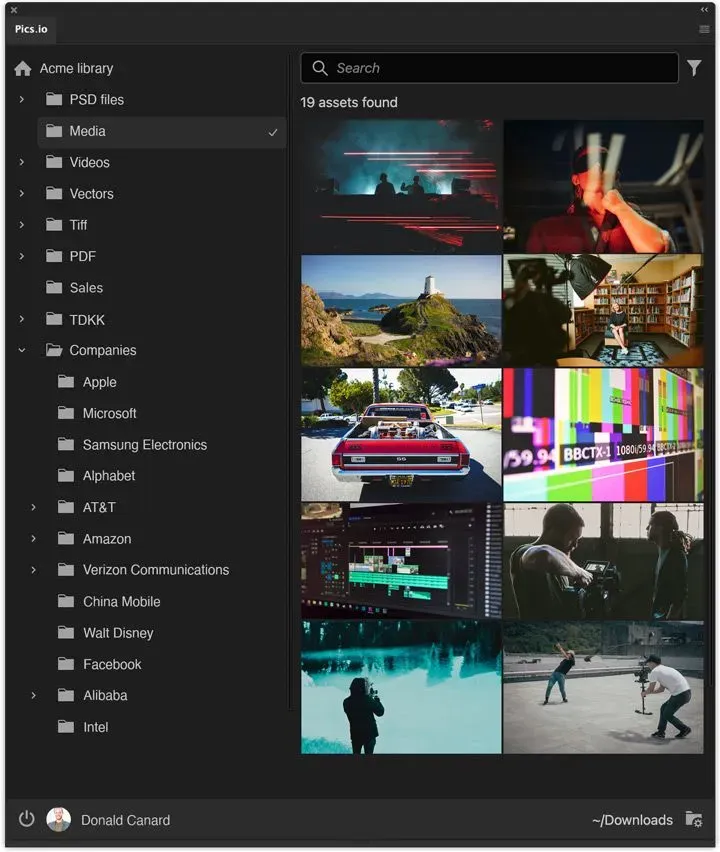
Now imagine that you work in a creative agency. Marketing, video production, photography, design agency – you name it. Without Adobe integration, you’re struggling to reconcile with all the inconveniences:
- Switching between different apps, windows, and tabs to select materials you’re planning to work with in Adobe.
- Wasting your time uploading & downloading your files millions of times;
- Complaining of a never-ending mess with your assets;
- Missing the right files all the time – you need to add one last stroke to your design, but the missing element is on the teammate’s local hard disk. And the teammates are on vacation somewhere in the other part of the world, so you cannot call them.
Pics.io & Photoshop
Preparing for a big marketing project, our imaginary creative agency (let's call it a marketing company) is working on product photography. Their clients have contacted them in anticipation of the launch of the new product line.
And so to showcase the product, our creative agency is running a professional photoshoot, with simple props, proper lighting, & all the rest, tinsel. Then it turns to Photoshop – the tool that can transform your photos into real artwork.
Integrated with Pics.io, Adobe Photoshop is a real pleasure to work with for our creative agency. The designer:
- Uploads elements & branding materials directly from Pics.io storage;
- Finds needed references in no time thanks to convenient search & the tree of collections;
- Reuses older designs to economize their time & continue the lifecycle of assets;
- Adds images as new layers, develops awesome designs, & saves them back to their media library.
Pics.io & Illustrator
The next step in our marketing campaign is to create a poster for the product line. Of course, Adobe Illustrator will help us best here. But don’t forget to integrate it into your DAM storage!Here’s how our imaginary designer’s workflow will look if their Adobe Illustrator is connected to Pics.io. The designer will be able to:
- Open and save graphics & vector files directly to the DAM.
- Use Pics.io's advanced search to find logos, typography, icons, and illustrations, and add them to the poster.
- Let the colleagues check the poster & share their ideas in the comment section.
- Save the design as a new revision to track all changes.
Pics.io & Premiere Pro
Could we launch the project without the perfect promo video? No way! Let’s make up the idea, choose the direction & tone, write the script, decide on the duration, style, etc., etc.
Shooting a professional video is the most challenging task here for sure. But the after-production stage may take forever for a reason as well.
In this case, our imaginary creative agency will rely on Adobe Premiere Pro. But it won’t forget about Pics.io, too. And so this explosive combination will grant it success:
- The team would store all essential video production assets in a centralized location, including storyboards, scripts, sound assets, and clips.
- The video editor will retract all these in one click.
- They will edit the promo video, refine & perfect it, and then save it back to storage.
- In Pics.io, the editor can also tag their teammates to review their final work & compare it to older versions.
Pics.io & After Effects
And if the same promo requires animation, our creative team will turn to Adobe After Effects. The tool works perfectly if you need to add digital visual effects, play with composition, & motion graphics.
But I’m guessing you know that better than me. Let’s learn how our marketing company would win if they connect their After Effects app to Pics.io. The company will be able to:
- Use keywords & metatags to find its assets in the blink of an eye & upload them to After Effects immediately;
- Build a quick & useful shortcut between its media library and the Adobe tool to add photos, videos, and graphics to the project;
- Keep all the promo versions in one place.
Pics.io & InDesign
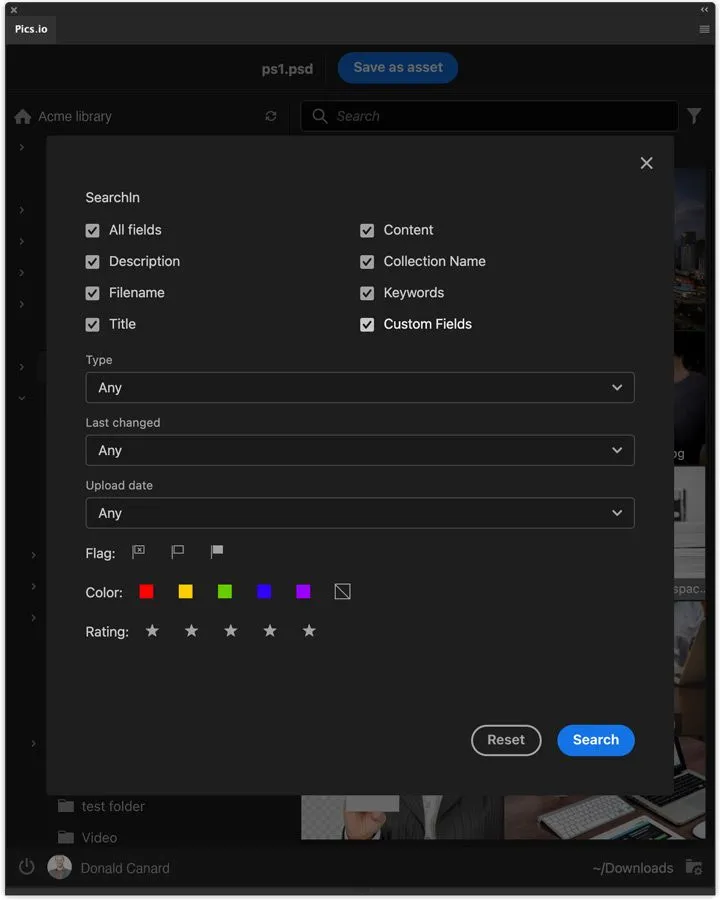
And now Adobe InDesign – our cherry on top! The big marketing campaign we’re developing won’t do without all sorts of marketing collateral: posters, flyers, presentations, etc. All these, our imaginary designer will work on in InDesign.
But now they’ll integrate the tool with Pics.io & benefit from a smoother workflow:
- Easy & straightforward connection between the media library & the Adobe tool;
- Advanced search for assets with the hierarchy of collections, keywords, & metatags;
- No clutter & disorder in your DAM storage;
- Ability to save your designs as new assets or revisions.
A bit of magic – and our imaginary marketing company is running a perfect marketing campaign. And Pics.io was a great help here!
How to integrate a DAM with Adobe Creative Cloud
- Check prerequisites. Make sure your DAM admin account is ready, and you have access to the right collections/projects. Confirm which Adobe apps your team uses (Photoshop, Illustrator, InDesign, Premiere Pro, etc.).
- Install the Adobe extension or plugin. Install the DAM connector from the official Adobe marketplace (or your DAM’s help center link). If your team is on managed devices, an IT/admin may need to approve the install.
- Sign in and connect your DAM. Open the Adobe app and launch the connector panel. Then log in to your DAM. Pick the right workspace/account if you have multiple.
- Set up folders/collections for real agency work. Create a simple structure like: Client → Project → Deliverables → Approved. Decide where “working files” live vs “approved assets” live (this matters for clean approvals).
- Search and open assets from inside Adobe. Use the connector panel to search by filename, tags, metadata, or collection. Open the asset directly in the Adobe app.
- Save updates back to the DAM the right way. Save as a new version when it’s the same asset evolving (recommended for ongoing work). Save as a new file when it’s a new deliverable (e.g., a new format/size/cutdown).
- Add context: metadata + notes (so approvals don’t fall apart). Add a short note like “Client v2: updated logo size + CTA”. Keep naming consistent for exports (e.g., client_campaign_format_language_v03).
- Test the workflow with a mini pilot. Pick one active project and run it end-to-end: draft → review → revisions → approved → delivery. Collect feedback from a designer, a PM/account manager, and adjust the structure once.
Don’t be shy to consult our Help Center to find a step-by-step guideline on how to add Pics.io to your Adobe Creative Cloud apps.
CC Libraries vs a DAM: Who should use what?
If your team mainly needs a shared “brand kit” within Adobe apps—logos, colors, templates, and small reusable elements—Adobe Creative Cloud Libraries may be enough. They’re built to keep frequently used creative ingredients close to designers, so you can drag and drop the right assets without hunting through folders.A DAM is a different kind of tool.
It becomes important when your agency has many clients, lots of deliverables, heavy files (video, layered sources, print packages), and a real review cycle. A DAM is where you keep the source of truth: versions, approvals, metadata, access rights, and fast search across the whole library—so people stop guessing what’s latest and what’s approved.
The simplest approach many agencies land on is using both: Libraries for reusable brand ingredients, and a DAM for project files and deliverables—the things you need to store, track, approve, and find later.
Wrap up
Adobe Creative Cloud is a favorite tool of many. Pics.io knows this really well and has added it to its list of integrations to optimize your workspace. Photoshop, Illustrator, Premiere Pro, After Effects, and now InDesign – all your cherished apps to work on your projects & access files from one app.
FAQ
Do I need admin rights to install the Adobe integration for the whole team?
Often yes—especially on managed devices. If teammates can’t install it, ask an IT/Adobe admin to approve and roll it out.
Which Adobe apps does the integration support?
Commonly, Photoshop, Illustrator, and InDesign (sometimes video apps too). The exact list depends on the connector—link your Help Center list here for clarity.
Will this replace Google Drive/Dropbox—or work alongside them?
Many teams keep Drive for documents and general files, but move creative assets into a DAM to avoid duplicates, version chaos, and messy approvals.
Can I restrict access per client or team?
Yes. A DAM typically supports role-based access and permissions per collection/folder, so different teams (and clients/freelancers) see only what they should.
How do approvals work—where do comments live?
The goal is to keep feedback attached to the asset (not scattered across chats). Most teams use comments/notes, along with a clear “Approved” area, to avoid confusion.
What’s the difference between CC Libraries and a DAM?
Libraries help reuse brand ingredients inside Adobe. A DAM manages assets at scale: versions, permissions, approvals, metadata, and searchable storage across the entire system.
Did you enjoy this article? Give Pics.io a try — or book a demo with us, and we'll be happy to answer any of your questions.
Author

Akinai is an experienced customer support leader who has managed teams of five+ people. She holds a Bachelor’s degree in International Business and has UX/UI design training, including a second-place finish at RadCode. In cross-functional meetings, she consistently brings the customer perspective to top management and key stakeholders.


